



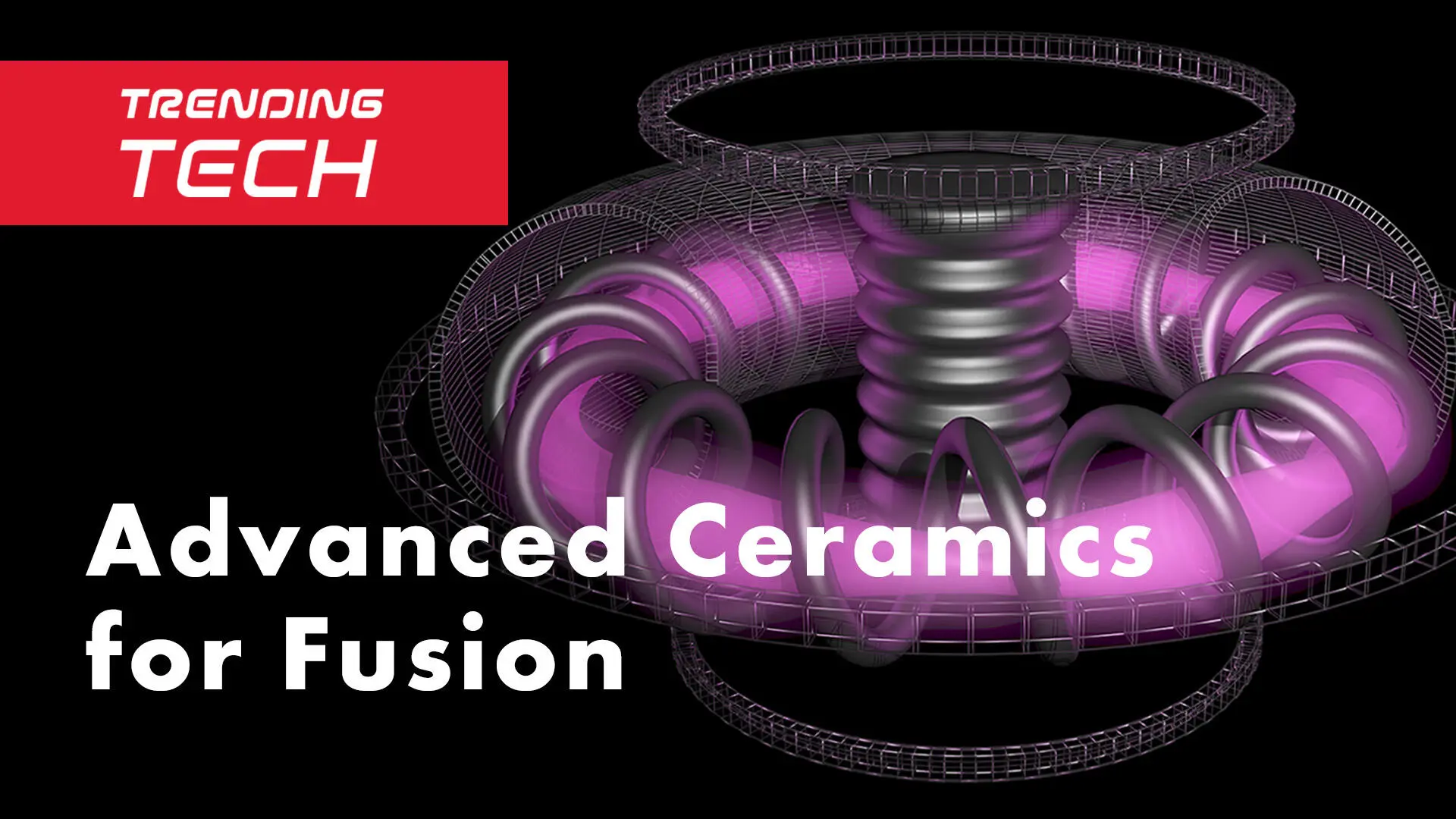
Fusion energy — often called the "dream energy" — strives to replicate the reaction fueling our sun to realize it as clean, stable, and abundant energy. Worldwide, the race to practical fusion is intensifying, drawing attention as a potential answer to global energy and climate challenges.
Reaching that goal, however, demands breakthroughs on multiple fronts, from taming ultra-high-temperature plasma to engineering materials that can survive extreme conditions. Advanced ceramics (also known as fine ceramics), in particular, hold remarkable promise in this arena.
Reaching that goal, however, demands breakthroughs on multiple fronts, from taming ultra-high-temperature plasma to engineering materials that can survive extreme conditions. Advanced ceramics (also known as fine ceramics), in particular, hold remarkable promise in this arena.
How fusion works — and why it matters
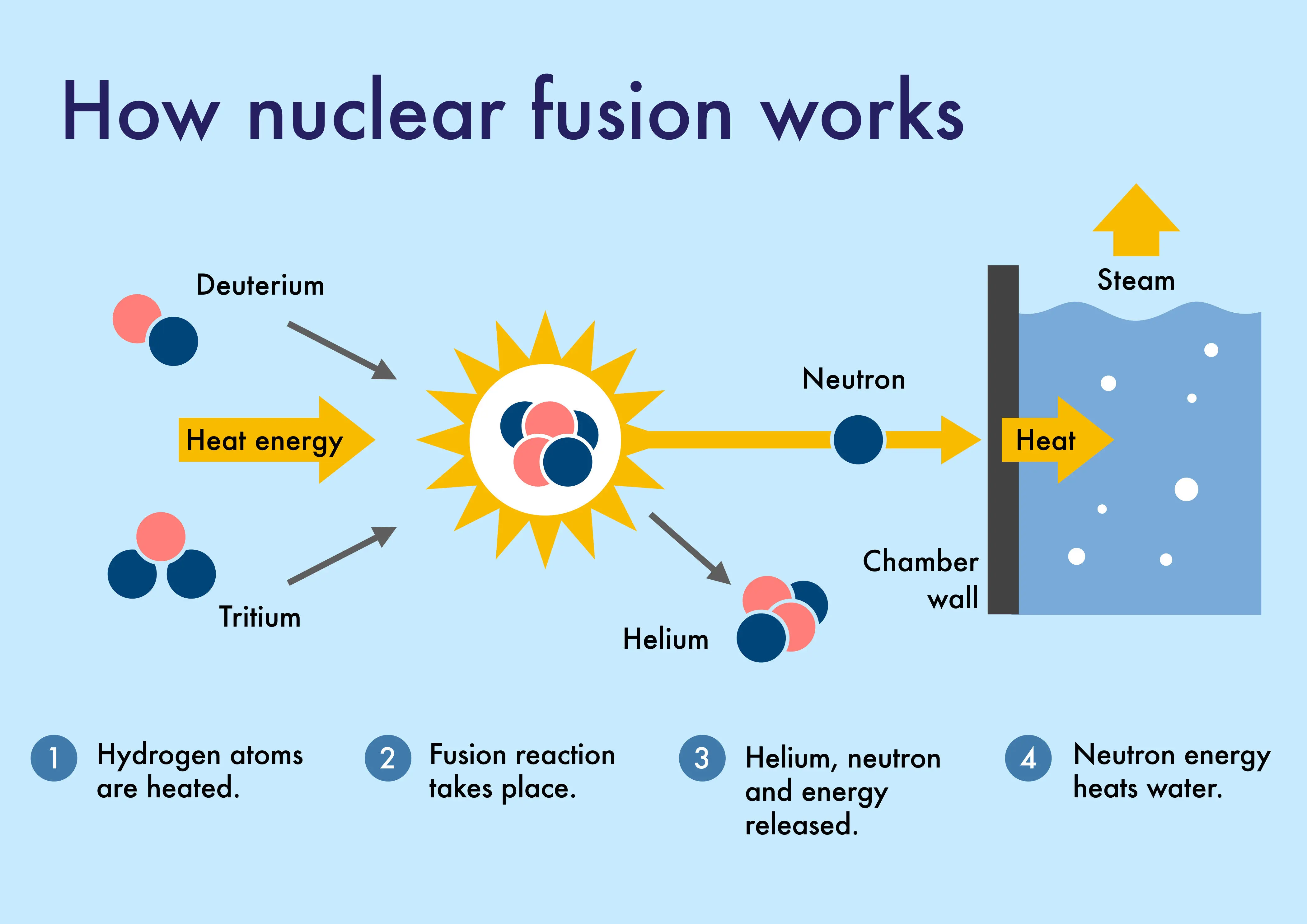
Fusion is the type of nuclear reaction that fuels our sun. Light atomic nuclei merge into heavier ones, unleashing enormous energy. In a fusion reactor, hydrogen isotopes — deuterium and tritium — heat past 100 million degrees Celsius, entering a plasma state where nuclei collide and fuse. A single gram of fusion fuel rivals roughly eight tons of oil or 12 tons of coal.
However, sustaining the reaction requires confining the plasma, a difficult endeavor. One leading method harnesses powerful magnetic fields from superconducting magnets to trap the plasma inside a doughnut-shaped vessel. A design called a “tokamak” has become the mainstream approach in the pursuit of practical fusion power on Earth.
Fusion power generation mirrors conventional thermal plants — heat produces steam, which spins a turbine. Yet fusion stands apart in fundamental ways:
・Virtually inexhaustible fuel: Deuterium, extracted from seawater, exists in practically unlimited supply.
・Minimal radioactive waste: The main byproduct of fusion is helium. Unlike fission, which leaves waste demanding management for tens of thousands of years, fusion generates almost no long-lived radioactive material.
・No meltdown risk: A fusion reaction halts naturally once the fuel supply is cut.
Why are advanced ceramics so important?
Inside a fusion reactor, components endure punishing conditions — searing heat, high voltage, and intense neutron radiation. Turning fusion into a practical energy source hinges on materials that thrive in this environment.
Advanced ceramics deliver outstanding heat resistance, electrical insulation, corrosion resistance, thermal conductivity, and radiation durability. These traits make them ideal for a wide range of reactor components, from structural parts and insulators to cooling and heat-management systems.
Insulating One Million Volts — A 1.56-Meter Alumina Ring for the ITER
The ITER — the International Thermonuclear Experimental Reactor — is a large-scale multinational experimental facility in France built to prove fusion as a safe, clean power source.
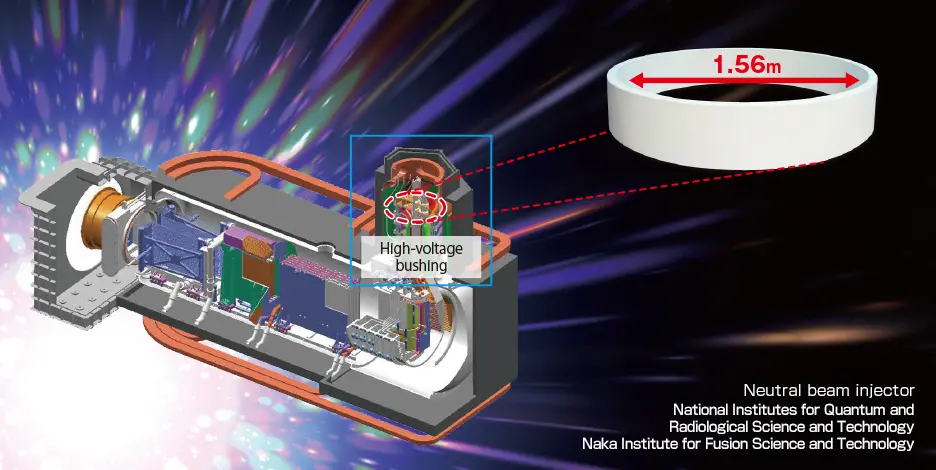
For this global project, Kyocera supplies a high-purity alumina (Al₂O₃) ceramic ring (an insulator) measuring 1.56 meters in diameter. It serves as a high-voltage bushing in the neutral beam injection system, insulating up to one million volts. Producing such a large ring with extremely tight dimensional tolerance while maintaining a uniform microstructure and consistent insulation performance was long a major hurdle in the field. However, through joint research with the Naka Fusion Institute of the National Institutes for Quantum Science and Technology (QST), the partners developed a new forming method for large-diameter ceramic rings, clearing that barrier.
The breakthrough reaches beyond fusion, promising gains for the semiconductor industry and academic fields such as particle physics.
The Next Materials Challenges — SiC Composites and SOEC Components
The ITER alumina ring tackles electrical insulation. But bringing fusion plants to life demands solutions to further materials problems.
One challenge is heat extraction. The immense heat released by fusion reactions must be captured efficiently and converted into electricity to make fusion a viable power source. A component called the "blanket," installed around the plasma, captures this thermal energy and houses lithium for tritium breeding.
Another is fuel security. Tritium, one of the two fusion fuels, has a half-life of roughly 12 years and occurs only in trace amounts in nature. The plan calls for producing tritium by using fusion-generated neutrons to trigger reactions with lithium.
Both challenges demand new ceramic materials capable of enduring extreme conditions. In Sept. 2025, Kyocera signed a joint development agreement with Kyoto Fusioneering targeting three areas:
1. Developing silicon carbide (SiC) composite materials for use in fusion energy plants
2. Creating components related to solid oxide electrolysis cells (SOECs) for efficient tritium recovery
3. Jointly exploring additional component technologies to support fusion plant development
The partnership fuses Kyocera's long-cultivated advanced ceramic technology and manufacturing expertise with Kyoto Fusioneering's command of fusion materials and engineering, accelerating solutions to pressing technical challenges.
The Road Ahead
Fusion no longer belongs to a single laboratory or a single country. ITER, advanced through global collaboration, continues marching toward its operational phase. The United States and the European Union lead a surge in fusion startups, and a growing roster of private companies, such as Kyoto Fusioneering and Helical Fusion, are broadening the field from public institutions into private industry.
But fusion energy is still at the frontier stage. The future of fusion energy is getting an acceleration from a 1.56-meter alumina ring insulating one million volts, SiC composites and SOEC components for blankets and fuel supply systems, and Kyocera’s long-cultivated advanced ceramic technology.
Learn more about advanced ceramics and fusion energy here:
Press Release: https://global.kyocera.com/newsroom/news/2025/001124.html
Fine Ceramics at Work in the ITER: https://global.kyocera.com/fcworld/consent/industry/large_diameter.html
SHARE



Latest Articles
-

KYOCERA TEACHES
Semiconductor back-end manufacturing overview
-
TRENDING TECH
Why fusion reactors need advanced ceramics
-

KYOCERA TEACHES
Front-end semiconductor manufacturing explained
-

KYOCERA TEACHES
Introduction to Fine Ceramics
-

KYOCERA TV
Kyocera Teaches: How MEMS shape our world
-
KYOCERA TV
Kyocera Teaches: MEMS Actuation Methods