




What are Fine Ceramics and why do they matter?
Every device you use daily — from your smartphone to your car — relies on electronics. These electronic systems are built from countless components working together behind the scenes.
Yet few people realize that many of these components depend on an advanced class of materials known as Fine Ceramics.
Even among technology industry professionals, when people hear the word "ceramics," they first imagine familiar consumer ceramic items such as tableware, tiles, sinks, or pottery. However, Fine Ceramics are fundamentally different. Rather than being made simply from natural materials, they are engineered materials developed through precise control of raw materials, composition, structure, and manufacturing processes.
This integration of material science and manufacturing technology allows Fine Ceramics to provide specific functions and characteristics advantageous for use in industrial settings that conventional ceramics cannot easily achieve. As a result, they have become important materials in modern technology industries, particularly in electronics and other industrial applications.
What makes Fine Ceramics different from conventional ceramics?
While Fine Ceramics belong to the same broad family, they are created with a fundamentally different purpose. Conventional ceramics typically rely on the natural properties of their raw materials. In contrast, Fine Ceramics are meticulously engineered to achieve specific functional characteristics through carefully controlled material composition and manufacturing processes.
The starting point is highly refined or synthesized powders as input materials, and key factors such as chemical composition, crystal structure, microstructure, grain boundaries, shape, and processing conditions are all precisely controlled. By managing these parameters, specialty manufacturers, such as Kyocera, can develop materials with targeted functions and characteristics for industrial applications.
The key distinction is that Fine Ceramics are not simply formed materials — they are engineered materials whose performance is intentionally designed from the beginning.
Characteristics of Fine Ceramics
The major characteristics of Fine Ceramics (also known as "advanced ceramics") can be divided into the following five categories.
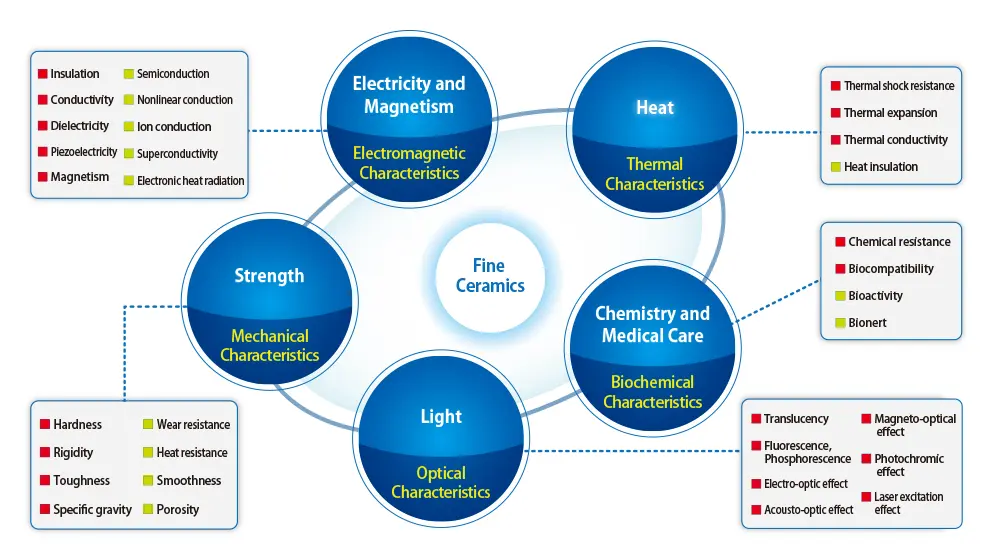
The Fine Ceramics developed by Kyocera are engineered and customized to exhibit a wide range of characteristics, including mechanical, thermal, electromagnetic, optical, and biochemical properties. By combining these functions, they enable applications across semiconductor, electronics, industrial equipment, healthcare, and many other fields.
Engineering better performance
Behind every breakthrough technology lies a series of engineering challenges. Improving reliability, enabling miniaturization, managing heat, and creating new functions all require materials capable of delivering highly specialized performance.
Fine Ceramics are one example of how advances in materials engineering continue to expand what the world’s most advanced technology arenas, from AI and data center to semiconductors and advanced mobility, can achieve.
References
What are Fine Ceramics? — Fine Ceramics World
https://global.kyocera.com/fcworld/first/about.html
Introduction to Fine Ceramics — Fine Ceramics World
https://global.kyocera.com/fcworld/first/index.html
SHARE


Latest Articles
-
KYOCERA TEACHES
Semiconductor back-end manufacturing overview
-

TRENDING TECH
Why fusion reactors need advanced ceramics
-

KYOCERA TEACHES
Front-end semiconductor manufacturing explained
-
KYOCERA TEACHES
Introduction to Fine Ceramics
-

KYOCERA TV
Kyocera Teaches: How MEMS shape our world
-

KYOCERA TV
Kyocera Teaches: MEMS Actuation Methods