Case Studies
Case Study(1970s)
Achieving a V-Shaped Recovery
after the 1970s Oil Shock
A V-shaped recovery made possible by company-wide rationalization and strong labor-management relations
Kyocera’s corporate culture and labor-management bonds were tested during a difficult time
The First Oil Shock in 1973 resulted in the first decrease in Japan's real GDP since the end of World War II, and Kyocera was also severely affected. By July 1974, orders had plummeted to about one-tenth of their peak, and production had to be significantly scaled back. While many companies rushed to lay off employees, Kazuo Inamori (Kyocera’s president at the time) was committed to protecting jobs based on the company’s Management Rationale “To provide opportunities for the material and intellectual growth of all our employees.” The unique recession countermeasures implemented under this policy served as a springboard to overcome the crisis of that turbulent era and achieve further growth.
Refusing to tolerate any decline in productivity, and a forward-looking, rational approach to staffing
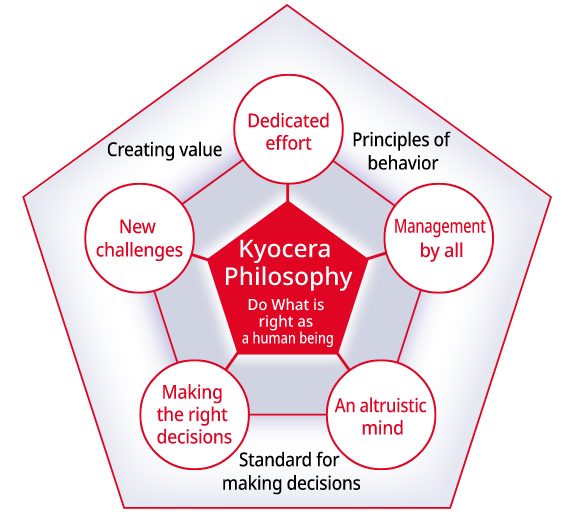
- #Making the Right Decisions
The decline in orders caused a surplus in personnel of as much as 30%, but Kyocera decided not to adopt the common work-sharing approach of evenly distributing the workload. This was because it was thought that increasing the number of workers on a production line that already had an appropriate number of staff would reduce productivity, making it difficult to ramp production back up when orders recovered. The production lines were thus kept running at full capacity with the same number of staff as before in order to maintain high productivity. Further, employees who were pulled from the production lines focused on technical training in preparation for when orders recovered, and also on plant maintenance and beautification work. Departing from conventional wisdom, the decision was made to maintain the hourly efficiency essential for managing the business while also protecting jobs.
“Every employee is a salesperson”
– developing new, outside-the-box products and sales channels
- #Management by All
In addition to streamlining production, Inamori urged employees to recognize that “every employee is a salesperson.” He explained that even if they didn't go out into the field to sell products, they were responsible for “selling trust in Kyocera” by crafting products from the user's perspective and greeting visitors politely with a smile. This shared vision that “every employee is a salesperson” led to many employees from the production department visiting customers to take orders, with some even transferring from production to sales. Inamori also solicited ideas for new products from everyone in the company, including departments not directly involved in development or production. One proposal from the materials department led to the production of ceramic white and black stones for the board game Go, with materials staff handling sales of the Go stones to clients, demonstrating cross-departmental collaboration. The strong sense of ownership and the collective effort of the entire team were the driving forces that enabled Kyocera to overcome the difficult circumstances.
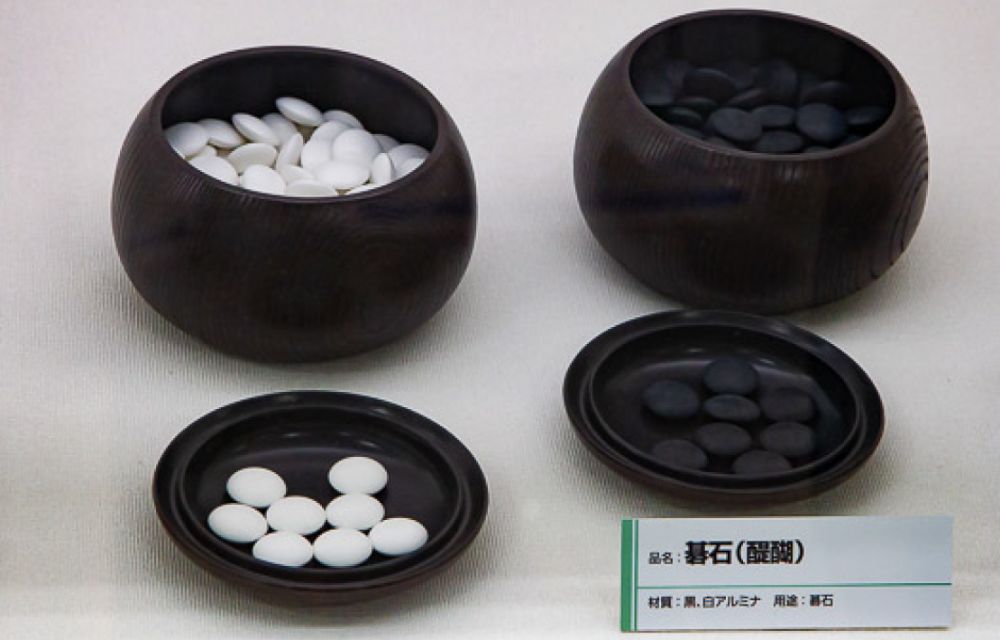
White and black ceramic stones for the board game Go
The labor union goes its own way and decides to share the pain
- #An Altruistic Mind
Faced with a prolonged recession, Kyocera’s management made the difficult decision to cut their own salaries. From November 1974, executives at the level of section assistant-manager and above, including Inamori, accepted salary cuts ranging from 7% to 30%. At the same time, the company labor union was asked to forgo any wage increase for the following year. This policy was intended to share the burden among all employees, rather than having to lay off a single worker. Taking into consideration the mutual understanding and trust that had been cultivated between labor and management over many years, the labor union's leadership unanimously voted to accept this tough proposal. Furthermore, when the “Zensendomei” labor union (the Kyocera labor union’s parent organization) instructed member unions to demand uniform wage increases, the Kyocera labor union decided to withdraw from Zensendomei, asserting that they could not follow instructions that disregarded the circumstances of individual companies. This decision by the labor union to forge their own path, a concern for the future of the company and its employees made with “An Altruistic Mind,” was a key factor in enabling Kyocera to overcome a very difficult situation.
Recovery ahead of other companies and
maximum rewards for all employees
- #Dedicated Effort
Thanks to the prompt, coordinated labor-management measures, Kyocera was able to improve its business performance ahead of other companies, and by June 1975, orders had recovered to pre-oil shock levels. Subsequently, driven by increased orders for ceramic multilayer packages and other products, performance improved even further, significantly raising the company's market standing. In September 1975, Kyocera surpassed Sony to become the highest-priced individual Japanese stock listing at 2,990 yen per share*. In the wake of this recovery, Inamori rewarded employees who had endured hardship by accepting salary cuts and forgoing wage increases and paid out the deferred spring wage hikes as a special bonus. Moreover, the following year, Inamori implemented a significant base wage increase as an expression of gratitude. Rather than using the worsening business environment as an excuse, the entire company worked together to reduce waste and rationalize operations. This culture of everyone aligning their vectors and making “Dedicated Efforts” has continued to be passed down at Kyocera even today.
*At that time in Japan, a high share price per share was considered one indicator of an outstanding company (in contrast to modern interpretations of corporate value, such as total market capitalization). In this context, when Kyocera achieved the highest share price per share, it was widely reported in the Japanese press.
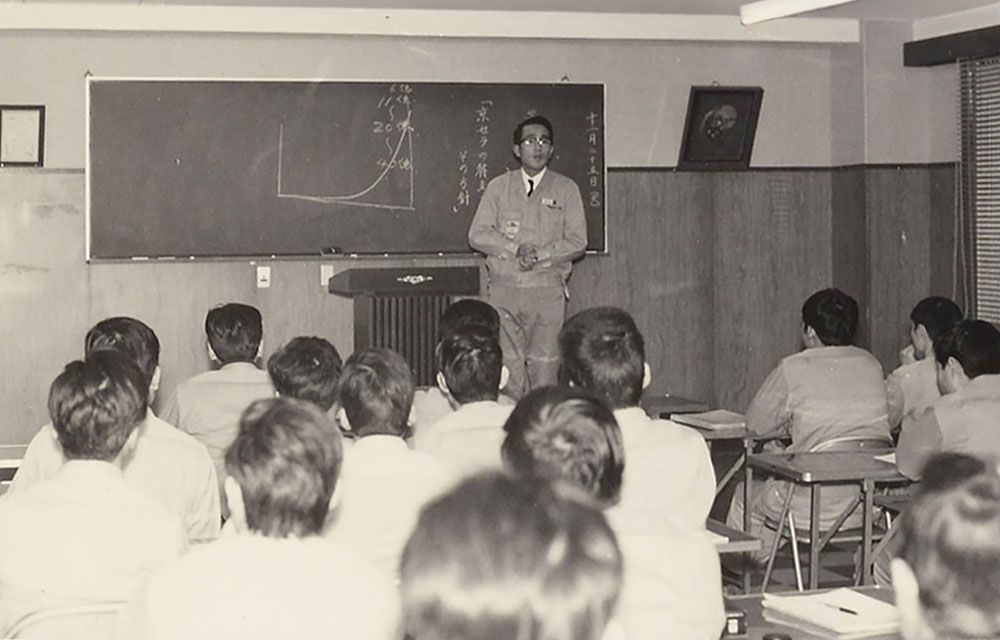
Inamori speaking to employees in 1975 about Kyocera's future policy


