Origin
Why Is a Philosophy Needed in Management?
— The Origin of the Kyocera Philosophy
A practical guideline for living and management developed by
Kyocera’s founder, Kazuo Inamori, based on his own life experiences
What criteria should be used for making decisions?
– clarity achieved through self-reflection
The Kyocera Philosophy is a management and life philosophy developed by Kazuo Inamori based on the hardships and difficulties he experienced in his own life and management. Why does Kyocera place such importance on the Philosophy for corporate management? To reach Kyocera’s lofty goal of becoming “The Company” — the ideal, most trusted and respected company anywhere in the world — common truths and principles are indispensable to unite all Kyocera employees and enable them to make the right decisions. The solid spiritual foundation of the Kyocera Philosophy is the powerful force that has made it possible for the company to overcome numerous difficult challenges and achieve continuous growth throughout our history. The origin of the Kyocera Philosophy can be traced back to the deep self-reflection and internal struggles that Inamori experienced at various turning points in his life.
How the Kyocera
Philosophy Originated
Guidelines for living that sprouted from
the soil of hardship
The source of the Kyocera Philosophy lies in the difficulties and hardships experienced by the young Kazuo Inamori as he faced the harsh realities of life, first being struck by a life-threatening illness at an early age, followed by disappointment at work. The foundation of the Philosophy was cultivated amidst those adversities.
Mindset determines one’s destiny
The origin of Inamori’s Philosophy was an event that occurred when he was just a young boy. Suffering from tuberculosis, an incurable and often fatal disease at that time, and having already lost several relatives to the disease, Inamori wondered if he might be next. Through a book titled Truth of Life, recommended by a neighbor, Inamori was struck by the concept that “Life unfolds as you envision it in your heart.” This experience, in which he keenly felt that his misfortune was actually attributable to his own weakness of spirit, marked a major turning point in Inamori’s realization of the importance of his mindset and way of thinking, which would later become the core of his Philosophy.
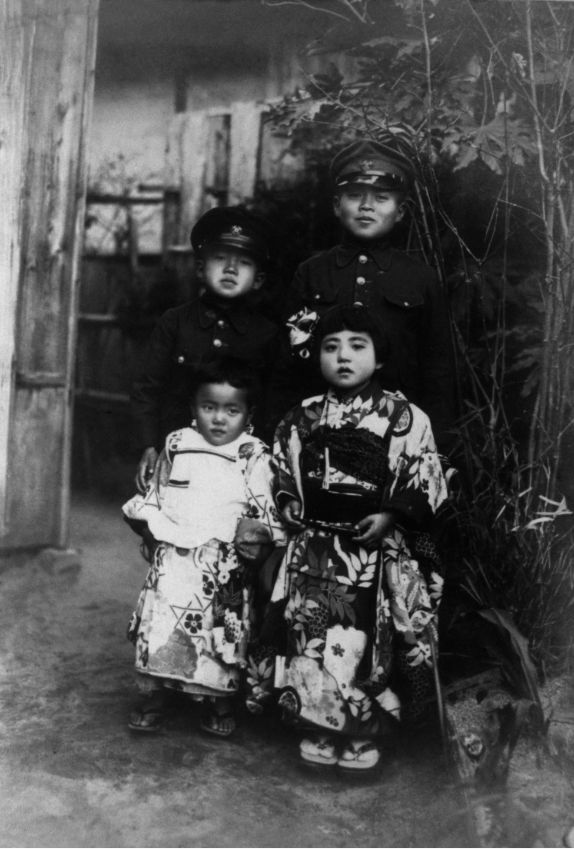
Inamori at around age 8 (back, left)
A philosophy for work scrawled in the margins of research notebooks
The seeds of Inamori’s Philosophy sprouted during his time of struggle at Shofu Industrial, where he had found employment after graduating from university. The company was constantly in the red, salaries were paid late, and his coworkers were leaving the company one after another. With no escape route, Inamori resolved to devote himself to his work and not moan about the situation. Bringing with him some pots and pans, he essentially started living at the company, dedicated himself entirely to research, and often even forgot to eat or sleep. This dedication culminated in his research producing world-class results. He believed that even an ordinary person could achieve extraordinary results if they dedicated themselves to their work. Inamori recorded the work philosophies and mindsets he had gained from this experience in his research notebooks, laying the foundation for the Kyocera Philosophy.
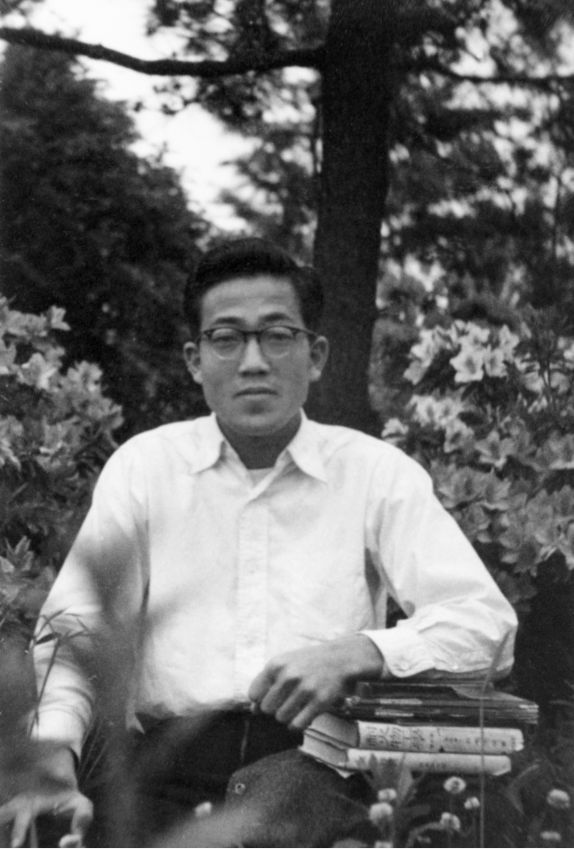
Inamori during his time at Shofu Industrial
Seeking the happiness of all employees
Inamori founded Kyocera at the age of 27. His initial goal was to showcase his technology to the world. But early in the company’s third year, Kyocera management was confronted with collective bargaining from young employees seeking job security. Seeing this as an event that fundamentally questioned the purpose of the company, Inamori deeply pondered the issue, and this experience led him to believe that the true purpose of the company was “To provide opportunities for the material and intellectual growth of all our employees.” To protect and ensure the happiness of employees, Inamori was absolutely determined that he could not let the company fail. Strongly feeling the need for a firm foundation to guide the company, Inamori distilled the words that he had once jotted down in his notebooks into policies for management.
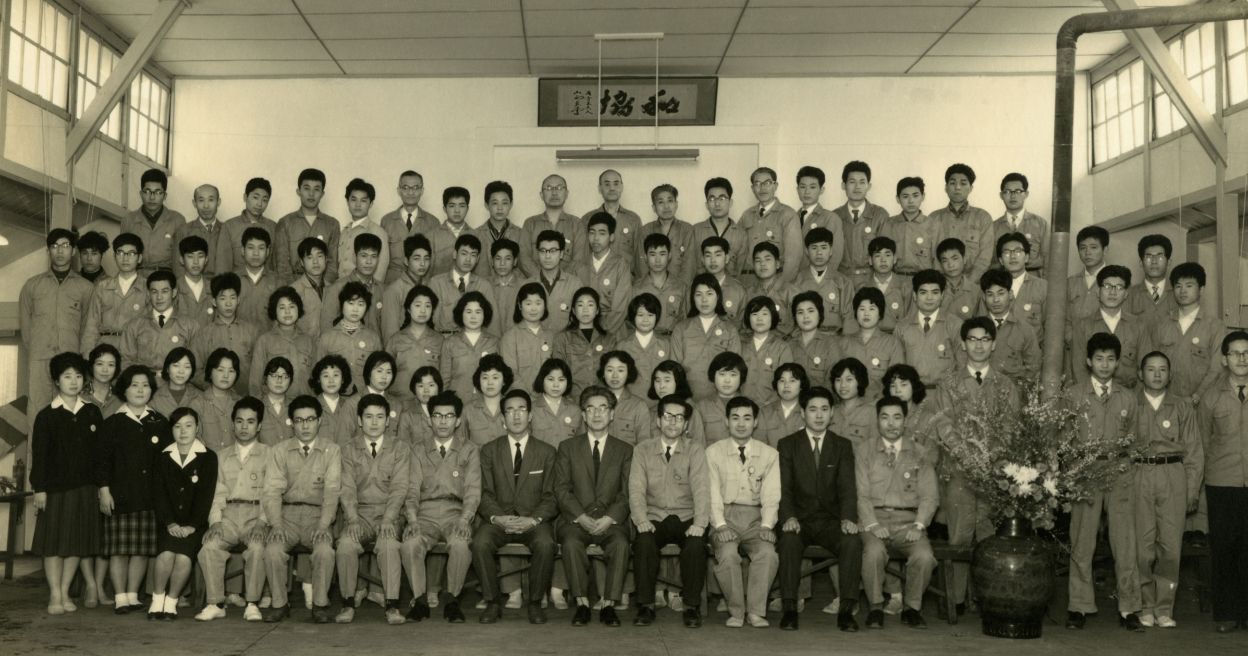
Commemorative photo taken on April 1, 1961, the company’s second anniversary, before management was confronted with collective bargaining
The Source of Growth
Aiming to become
No.1 in the world
From the start, Kyocera aimed to be the world’s greatest, setting forth on a journey to become an ideal company that aimed to ensure the well-being of all employees. As the company grew from a small factory into a medium-sized company, and with Inamori leading the way as president, the words he had once jotted down in his notebooks became an unwavering guide for uniting the hearts of all employees. As the business grew, a solid foundation was needed to align everyone’s vectors in order to achieve the company’s high goals.
Philosophy is to management as the right
equipment is to climbing Mount Everest
To achieve Kyocera’s goal of becoming the greatest company in the world and realize the ideal of doing everything possible for its employees’ well-being, a strong mindset was required. Why is a philosophy necessary for managing a company? Inamori invariably explained the reason by using the analogy of mountain climbing: “To hike up a nearby low mountain, common sense dictates that light equipment is sufficient. But what we’re aiming for is Mount Everest, the world’s highest peak. To reach that peak, we need heavy equipment capable of tackling the snow-covered route, advanced skills, and above all, rigorous training.” The Kyocera Philosophy is the essential equipment needed to achieve the goal of becoming the greatest company in the world.
The “Kyocera Spirit” set down in Inamori’s
handwritten texts
So what exactly was that “equipment”? In 1967, in announcing his management policy shortly after becoming president, Inamori — at the time in his early thirties — summarized in his own handwriting the mindset that all employees should possess as the “Kyocera Spirit.” Below is the original text.
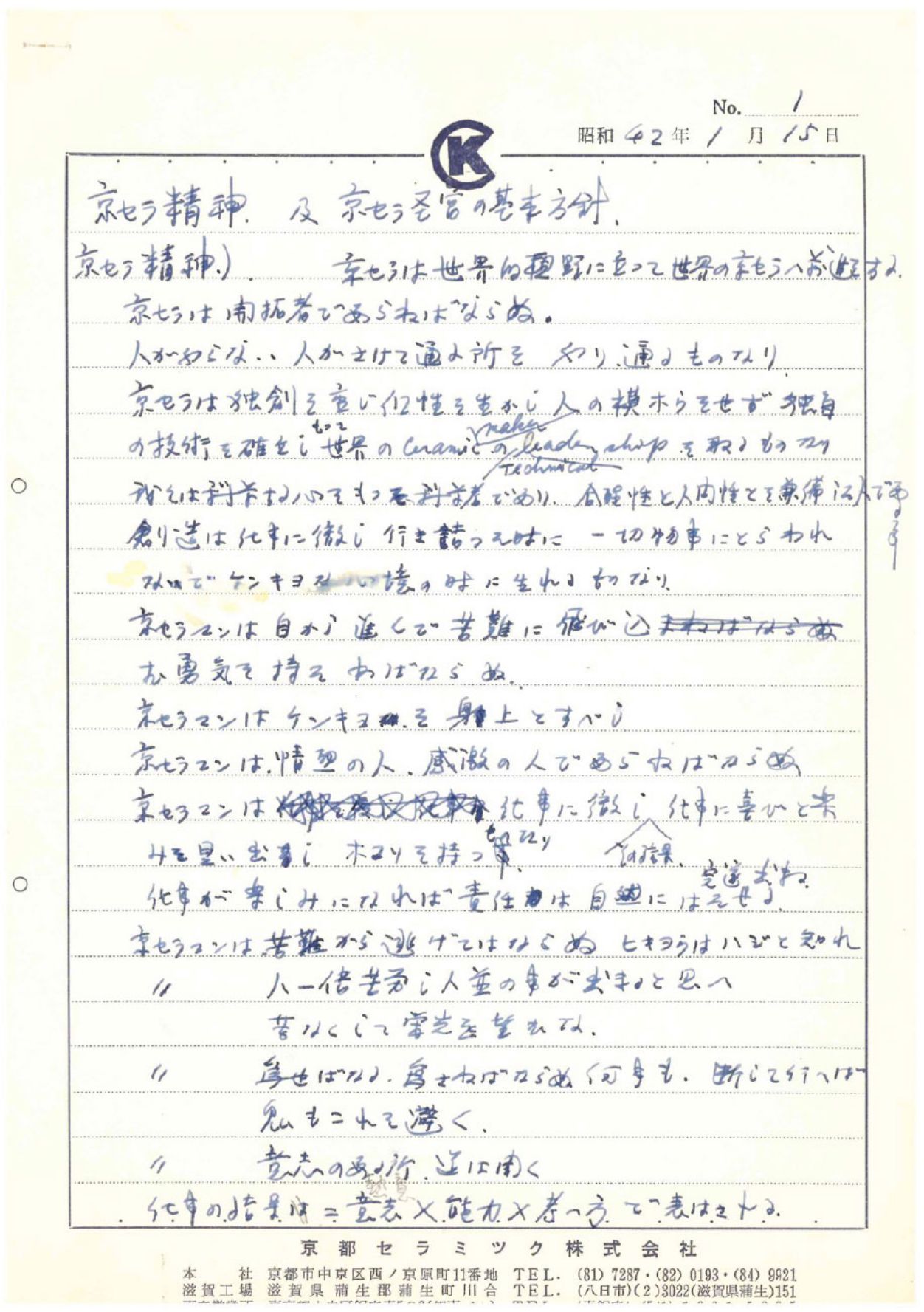
January 15, 1967
The Kyocera Spirit and key principles of management
The Kyocera Spirit
- Kyocera seeks to become the Kyocera of the world from a global perspective
- Kyocera must be a pioneer. Do what others do not, and tread where others avoid
- Kyocera values originality, leverages individuality, establishes original technologies without imitating others, and engages in technical leadership among the world’s ceramic makers
- We are scientists with scientific minds, and possess both rationality and humanity
- Creation emerges when you are dedicated to work, are unbound by any constraints when you become stuck, and are of a humble state of mind
- Kyocera people must have the courage to plunge into hardship of their own will
- Kyocera people must be humble
- Kyocera people must be passionate and inspired
- Kyocera people will naturally meet their responsibility (accomplishment) if they are devoted to their work, and, as a result, find pleasure and joy in their work, take pride in their work, and enjoy their work
- Kyocera people must not turn their backs on hardship and are ashamed of cowardice
- Kyocera people must work harder than others, think they can do whatever others can, and never aspire to glory without effort
- Kyocera people can succeed if they try, and if they commit to the impossible, not even the gods can stand in their way
- Kyocera people must know where there is a will, there is a way
- The Result of Work = Effort (Passion) × Ability × Attitude
Omitted
This Kyocera Spirit, which was expressed in written form together with the principles underlying what Inamori had resolved as president, was later compiled into the Kyocera Philosophy, a powerful force that has supported the company’s growth to this day.
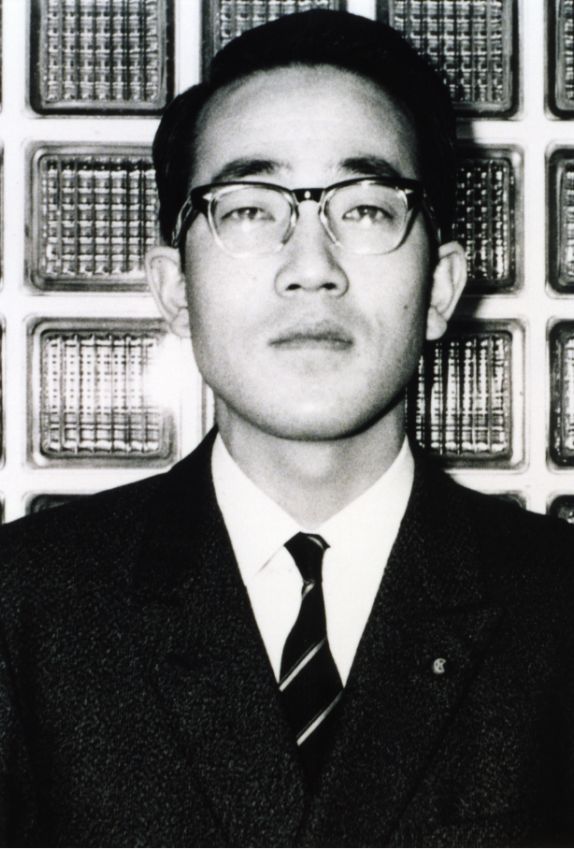
Inamori at the time he became president (1966)
Connecting to the Future
Passing on a “Universal Spirit”
The Kyocera Philosophy is a management philosophy that Inamori conceived through self-reflection and practical experience while facing numerous difficulties and constantly debating with himself about the best way to proceed. It is a way of thinking that leads to truths and principles based on the question, “What is the right thing to do as a human being?” and it embodies a universality that transcends both time and national borders.
Past successes and future challenges
The shared values of the Kyocera Philosophy continue to live on as the driving force of the Kyocera Group. The historical record of how Kyocera has overcome numerous crises in the past and achieved remarkable growth is proof of how the Kyocera Philosophy, as a set of management principles, can produce tangible results. At this very moment, Kyocera Group employees of diverse backgrounds around the world are carrying this spirit forward, relying on it as the standard for making decisions in their daily work.


