Kyocera Corporation (President: Hideo Tanimoto; "Kyocera") today announced that it has developed an industry-first*¹ inkjet printhead ("printhead") capable of handling high-viscosity materials for industrial applications. This breakthrough is enabled by Kyocera's proprietary new piezo actuator and fluid channel technology.
The new printhead is expected to expand the use of inkjet technology in a wide range of industrial applications, including advanced manufacturing processes, painting and 3D printing, which have been difficult to address using conventional inkjet technology.
*1: Among inkjet printheads with more than 1,500 nozzles capable of handling viscosities of 80 mPa・s or higher; Kyocera research, January 2026.
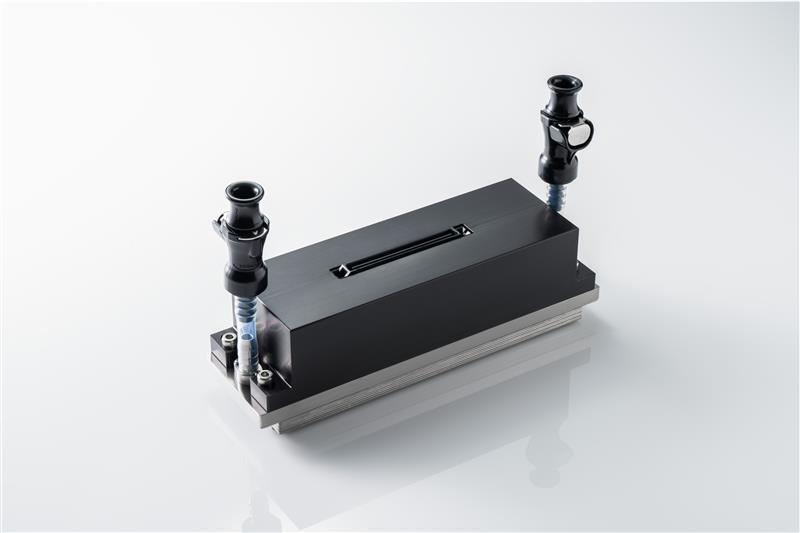
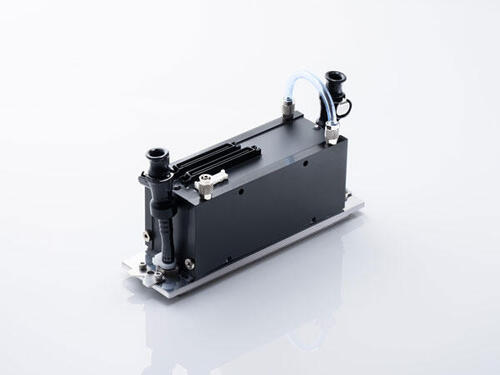
Example of prototype under development.
|
Main Features 1. New Actuator Structure Allows Higher Viscosities, Larger Droplets 2. Optimized Fluid Channel Design Allows Higher Viscosities, Larger Droplets |
■ Development Background
In recent years, the manufacturing industry is increasingly required to improve production efficiency in addition to reducing environmental impact and material waste to realize a sustainable society. Inkjet technology is highly regarded for its contribution to sustainability, as it enables the on-demand jetting of uniform, fine droplets, resulting in high material utilization efficiency and reduced waste.
Due to these characteristics, inkjet technology is attracting more attention as an innovative manufacturing process in fields such as electronic circuits, semiconductor production lines, and additive manufacturing*2. In addition, in automotive painting applications, efforts to develop practical inkjet processes are underway to enable more creative designs, reduce labor in masking processes and minimize paint loss.
Leveraging the strengths cultivated through years of printhead development -- namely high productivity, high resolution, and high durability -- Kyocera has successfully developed technology that enables the stable jetting of high-viscosity materials. As a result, manufacturing processes that use paints and materials in viscosity ranges that were previously difficult to handle with inkjet technology have now reached a practical stage.
Kyocera will continue developing innovative technologies to reduce environmental impact, promote labor efficiency and lead the digitalization of manufacturing.
*2: Additive manufacturing refers to a group of manufacturing technologies in which materials are layered to create three-dimensional structures.
Applications

Painting: automotive decorative coatings
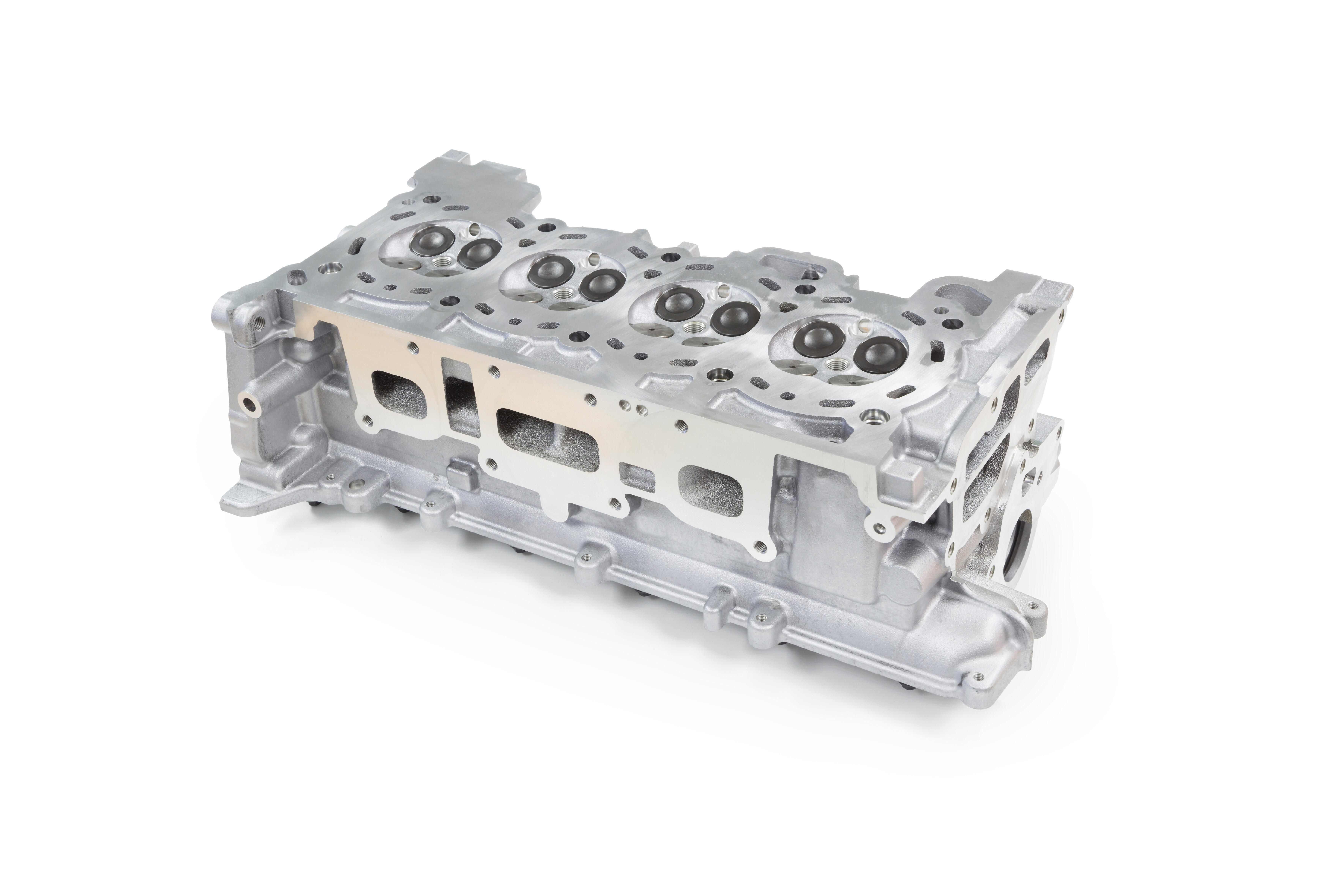
3D Printing: Molds and tooling to produce complex components such as cast aluminum engine parts.
■ Features
1.New Actuator Structure Allows Higher Viscosities, Larger Droplets
By leveraging the conventional piezoelectric bend mode*3, Kyocera has developed a proprietary new piezo actuator structure that enhances jetting force. This advancement enables the stable jetting of high-viscosity materials -- up to 16 times higher than Kyocera's conventional technology -- and droplets up to 20 times larger. As a result, the technology enables expansion into a wide range of industrial applications, including painting and 3D printing, which were previously difficult to address with inkjet technology.
*3: Piezoelectric Bend Mode: A method in which a piezo actuator ejects ink by utilizing deflection generated by the piezoelectric effect.
2.Optimized Fluid Channel Design Allows Higher Viscosities, Larger Droplets
In circulating printheads for high-viscosity materials, stable jetting has been a significant challenge. To address this, Kyocera has optimized the fluid channel design by leveraging proprietary fluid simulations. As a result, stable jetting is enabled, contributing to both improved productivity and quality.
■ Product Details
| Resolution | 360dpi × 360dpi |
| Effective print width | 111.69mm |
| Number of Nozzles | 1,584 |
| Viscosity*⁴ | 80mPa・s |
| Drop volume*⁴ | 280pL |
* 4: Jetting at the above viscosity and drop volume has been confirmed under Kyocera's evaluation conditions. (Actual jetting performance may vary depending on liquid characteristics and jetting conditions.)
Through this technology, Kyocera will continue to create new options for industrial inkjet applications and a more sustainable global environment.