Notable Moments
Success in Mass Producing the U-Shaped Kelcima (1955)
Upon joining Shofu Industrial, Inamori was assigned to the development of forsterite porcelain.
Forsterite's material properties make it suitable for use in insulating applications, including the "U-shaped Kelcima" within the cathode ray tubes of early TV sets, demand for which was rapidly increasing. If successful in producing the U-shaped Kelcima, which was imported from Western suppliers and not available from any Japanese manufacturer, Shofu Industrial could expect large orders from Matsushita Electronics. Consequently, they commenced development of forsterite porcelain and assigned Inamori to the project as soon as he joined the company.
The process began by synthesizing high-purity forsterite powder from oxide raw materials, followed by manufacturing the U-shaped Kelcima from pure forsterite material. The biggest challenge in commercializing the product was powder molding.
In traditional ceramic manufacturing, molding was done by mixing clay and water into the raw material powder. However, in making high-frequency insulation components, mixing other materials into forsterite reduces its insulation performance.
Molding pure forsterite powder is very difficult, because it is not easily solidified under pressure. Initially, they molded the powder using conventional methods, striving to use as little clay and water as possible to bind the powder into a moldable material. At the same time, Inamori continually experimented to see if he could improve high-frequency insulation performance by sintering pure metal oxides with no other materials added.
One day, Inamori stumbled upon a lump of paraffin wax under his laboratory table. Annoyed that it had been left there, he tried to retrieve it, but the wax stuck to his shoe. Paraffin wax is a product of oil refining. It solidifies at room temperature and melts when heated. It is also used as a raw material for candles.
The wax sticking to his shoe inspired Inamori to try paraffin wax as a binder for his forsterite powder.
When the two were mixed and heated, molding the powder became very easy. Best of all, during the firing process, the wax cleanly evaporated from the mold, resulting in ceramics consisting of pure forsterite. Since it did not require water, unlike conventional clay, no deformation occurred due to evaporation while firing, allowing intricately shaped ceramic objects to be created with high precision.
Inamori thus succeeded in manufacturing forsterite U-shaped Kelcimas that demonstrated excellent insulation performance in high-frequency applications. Developing and commercializing this material gave him a great sense of accomplishment and fulfillment as an engineer. The development and manufacturing experience he gained became the basis for Inamori's founding of Kyoto Ceramic.
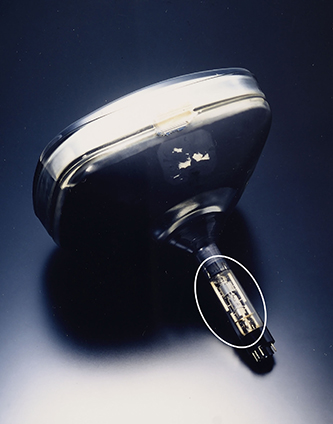
U-shaped Kelcima mounted inside cathode ray tube