Exhibitions
2019: "The Driving Force Behind Kyocera's Development: Our Management Philosophy"
The most significant factor in Kyocera's rapid growth and development to date is how individual employees have resonated with our "management philosophy" and worked hard to attain their own fulfillment while contributing to the advancement of society and humankind.
This exhibition focuses on the philosophy that drives Kyocera's development, highlighting how it was created and the challenges undertaken in bringing it to life.
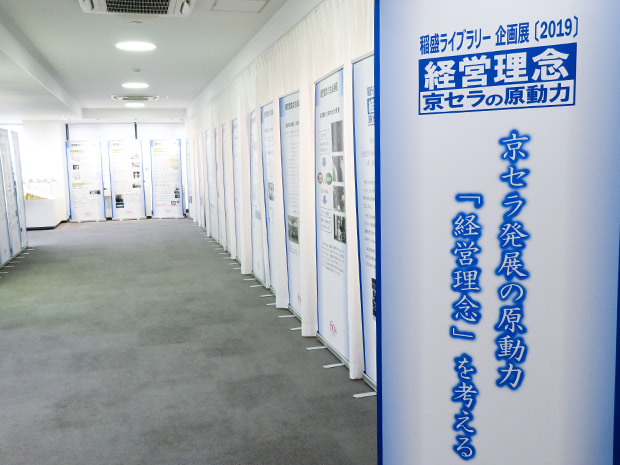
Exhibit Panels About Kyocera's Management Philosophy
① How Kyocera's Management Philosophy Was Born
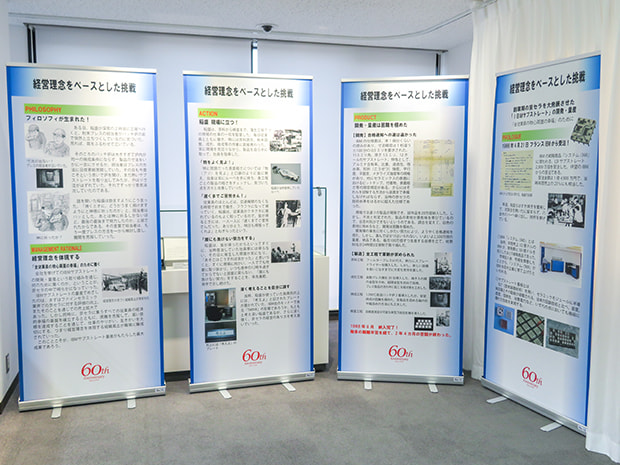
At the time of Kyocera's founding, there was a tendency for managers and employees to be at odds with each other. Amid this, Inamori learned a lesson from the objections of his own employees: "Management must have a righteous cause beyond their own selfish desires." This section of the exhibition introduces how Kyocera's management philosophy was established, its characteristics, and the process that led to its codification.
② Ideas Encapsulated in the Management Philosophy
This section introduces the importance of having a firm purpose for running a company, along with Inamori's view on the purpose of management.
③ Challenges Fueled by Our Management Philosophy
Introducing two pivotal challenges brought to success by our management philosophy.
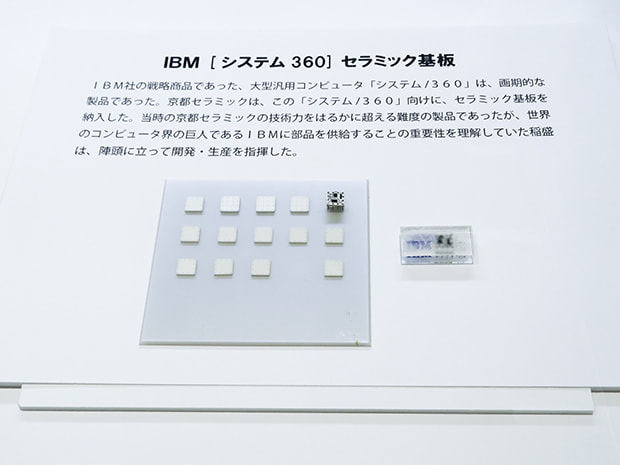
The IBM Opportunity
In April 1966 Kyocera received an order for 25 million LSI substrates to be used in IBM's "System/360" mainframe computer, a new modular concept that would change the IT industry. Totaling 149 million yen in revenue, this order represented a big success for Kyocera. To meet IBM's advanced technical requirements, Kyocera worked diligently on all development and production processes, going through countless hardships to complete delivery. Through the development and mass production of this IBM substrate, the purpose of Kyocera's work became clear. In overcoming difficulties and achieving high goals, a work culture and management philosophy that value job satisfaction and the joy of life was cultivated in the workplace.
The Diversification Story
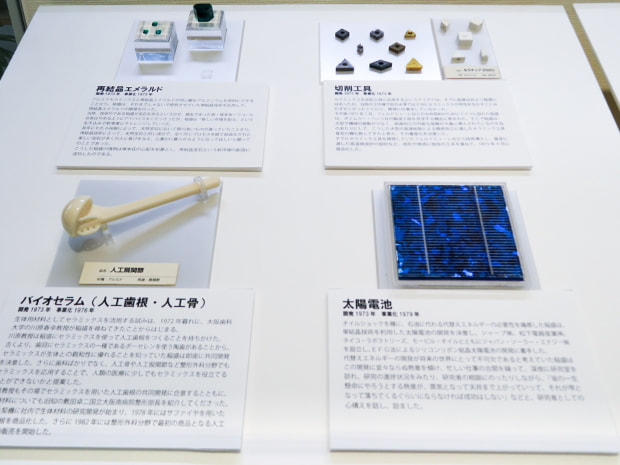
Diversification is necessary to ensure a company's stable growth. Inamori, as honorary chairperson, noted, "If a company stands on one leg, and that leg breaks, the company collapses. I would prefer to stand on two legs than one, and three legs rather than two. That's diversification." The oil shock of 1973 was the impetus for Kyocera to make diversification a priority. The company declared a state of emergency to protect jobs and withstand the downturn, and began thorough cost-cutting and mobilizing senior employees. It became clear that diversification was necessary to ensure the well-being of Kyocera's work force, as it was difficult to stabilize the operations with a single business. As an action plan to overcome the crisis, the following four new businesses were proposed:
- Recrystallized gemstones
- Cutting tools
- BIOCERAM medical and dental ceramics
- Solar cells
In the 1970s, these four businesses progressed rapidly from development to commercialization. The reason Kyocera established these businesses was that the company believed in the infinite potential of fine ceramics and had an unwavering management philosophy as its foundation.
Video Presentation: "Kyocera History: The Birth of a Management Philosophy"
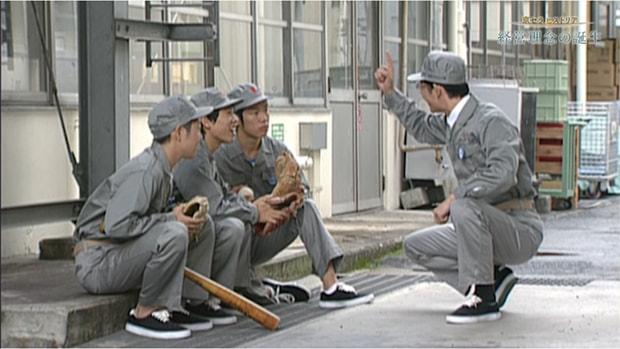
"Kyocera History: The Birth of a Management Philosophy," outlines conditions at the company around the time its management philosophy was created, and delves into the philosophy's meaning and background. The approximately 13-minute video also includes reenactment footage and interviews with Inamori.
*You can watch this video at The Inamori Library; if you are interested in viewing, please ask staff when you visit.