Notable Moments
Origins of Amoeba Management and the Hourly Efficiency System (1963)
Together with the opening of the Shiga Plant (currently Shiga Higashiomi Plant Block 2) in 1963, Kyocera introduced the Hourly Efficiency System and Amoeba Management.
By introducing the concept of "added value," the Hourly Efficiency System enabled fair comparison and evaluation of two manufacturing divisions with different operations. Taking Hourly Efficiency as an indicator, the headquarters plant strove to increase added value by further improving its technological capabilities and developing more challenging and high-value products. At the same time, the Shiga Plant, which handled mass-produced products, strove to increase added value by improving productivity and increasing production volume.

Around the same time as the Hourly Efficiency System, Kyocera also introduced a unique management system, Amoeba Management. Since Kyocera's founding, Inamori had spearheaded all aspects of the company, from development to manufacturing and sales. However, as the company grew, managing everything alone became problematic.
The idea was to divide the company into small organizations and for each to run as its own profit center. The organization is divided into optimal units such as products, processes, and profitability, and the organization itself and number of employees can be flexibly changed according to the business environment. This is why the system was called "Amoeba."
Each and every member of an amoeba is indispensable, and since team members can clearly understand the management situation of their amoeba through Hourly Efficiency, they develop a greater awareness of being participants in management. All team members are encouraged to look at the Hourly Efficiency table, think about what they can do to achieve the amoeba's goals, and work on their daily tasks with originality and ingenuity. Because the organization is small, individual efforts are immediately reflected in the amoeba's performance and staff can easily see how much they have contributed to the group, which leads to satisfaction and motivation for everyone. Inamori's Amoeba Management is not only an effective training system for young staff who will lead the next generation, but also a management system in which each employee can take the initiative to demonstrate their abilities.
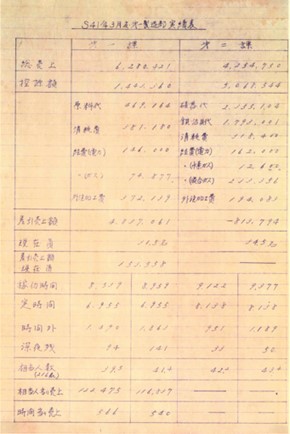
Photo: Annual Hourly Efficiency table (Inamori Library exhibit)