Technology
Solar Cell
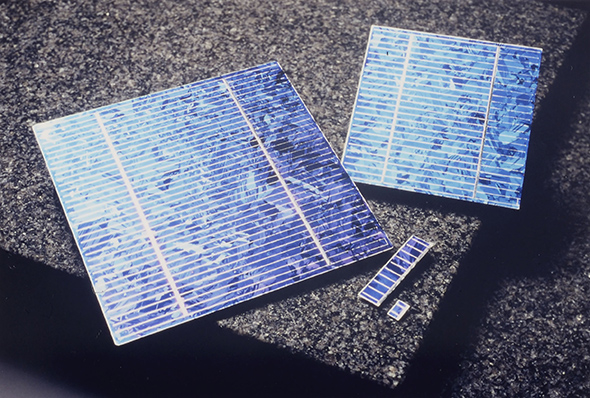
Solar cell technology is one of the fields that most clearly reflects Inamori's foresight and passion.
In 1973, when the first oil crisis shook the world and revealed the vulnerabilities of relying on fossil fuels, Inamori became convinced that renewable energy was essential for the sustainable development of humanity. His focus turned to solar cells, devices that convert sunlight directly into electricity.
At that time, silicon-based solar cells were still far from commercial viability and faced numerous business challenges. However, Inamori recognized that silicon was abundant on Earth and held strong potential for future cost reductions. With this conviction, he made the bold decision to fully commit to the solar cell business. As the Japanese government launched its "Sunshine Project" to promote renewable energy, Kyocera, under Inamori's leadership, accelerated its solar cell development efforts.
The company's first major initiative was adopting the EFG (Edge-defined Film-fed Growth) method from Mobil-Tyco Solar Energy to produce silicon ribbon crystals. After about five years of development, Kyocera achieved significant progress in mass production technology and conversion efficiency. However, the EFG method revealed limitations for large-scale production. Recognizing this challenge, Inamori decided in 1982 to shift to cast-multi-crystalline silicon technology, introduced from Germany's Wacker Chemie.
This casting method involved melting silicon to form ingots, slicing them into wafers, and then fabricating solar cells. Although multi-crystalline silicon cells had slightly lower efficiency than single-crystal cells, they offered substantial cost advantages and were ideal for mass production. Inamori established an integrated production system, from raw materials to finished modules, aiming to balance quality with cost competitiveness.
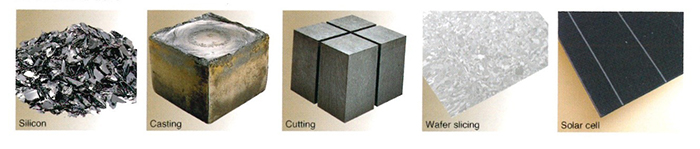
Photo: From Silicon to Solar Cell
Guided by the principle of "always striving to be the best in the world," Kyocera continued to develop innovative technologies to improve crystal quality and boost conversion efficiency. By the 1980s, the company achieved world-class efficiency levels and maintained industry leadership into the 2000s through ongoing improvements in performance and cost reduction.
In 2013, Kyocera began producing high-efficiency monocrystalline solar modules, further advancing Inamori's vision to contribute to the future of humanity and the planet. The history of Kyocera's solar energy business stands as a testament to Inamori's unwavering spirit of "challenge" and "conviction."