Kyocera achieves world's highest solar cell conversion efficiency
Kyocera's 10×10cm multicrystalline solar cells achieve 15.1% energy conversion efficiency, setting a world record for cells of this type. In 1989, Kyocera’s 15×15cm cells push the record for that size class to 14.5%, and then to 17.7% in 2004.
1991
Japan's first grid-connected solar electric system
Kyocera installs Japan's first grid-interfacing solar system for a general facility conforming to official guidelines in Kitami, Hokkaido Prefecture. In the same year, Kyocera completes a solar module production system with an annual capacity of 6 megawatts, the largest in Japan at the time.
1992
As a result of a research project commissioned by NEDO, shipments of portable solar power generating systems to Mongolia begin.
1993
Residential solar power generation systems released in Japan
Kyocera begins marketing residential solar power systems in 1993. Starting in 1994, the Japanese government launches a subsidy program promoting the use of these systems.
1993
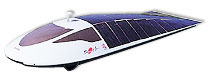
Kyocera’s “Son of Sun” solar-powered racing vehicle is developed and finishes third in the World Solar Challenge
1989
Kyocera develops "SEV" solar powered racing car.
1990
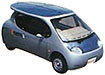
Develops short-distance solar powered car "SCV-O" (a model car was manufactured in 1995).
1990
"Blue Eagle" solar powered racing car is produced for the 1990 World Solar Challenge, a trans-continental race across Australia.
1993
"Son of Sun" solar powered racing car places third in 1993 World Solar Challenge.
1988
Achieved world's highest conversion efficiency of 15.5% with multicrystalline silicon solar cells (10×10cm).
1990
Achieved a top share in Japan's Ministry of Industry and International Trade special public use solar generation system program.
1993
Achieved world's highest conversion efficiency of 19.5% with monocrystalline silicon solar module components (10×10cm).
1994
Top market shareholder in the Japan solar industry according to the Ministry of Industry and International Trade (MITI) residential solar generation system monitor program.
1995
Established mass-production technology of enlarged multicrystalline silicon solar cells components (10×10cm to 15×15cm).






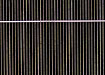 Kyocera's 10×10cm multicrystalline solar cells achieve 15.1% energy conversion efficiency, setting a world record for cells of this type. In 1989, Kyocera’s 15×15cm cells push the record for that size class to 14.5%, and then to 17.7% in 2004.
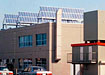 Kyocera installs Japan's first grid-interfacing solar system for a general facility conforming to official guidelines in Kitami, Hokkaido Prefecture. In the same year, Kyocera completes a solar module production system with an annual capacity of 6 megawatts, the largest in Japan at the time.
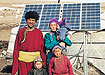 As a result of a research project commissioned by NEDO, shipments of portable solar power generating systems to Mongolia begin.
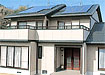 Kyocera begins marketing residential solar power systems in 1993. Starting in 1994, the Japanese government launches a subsidy program promoting the use of these systems.






 Top of page