Social Activities
Kyoto Prize
What is the Kyoto Prize (Inamori Foundation)?
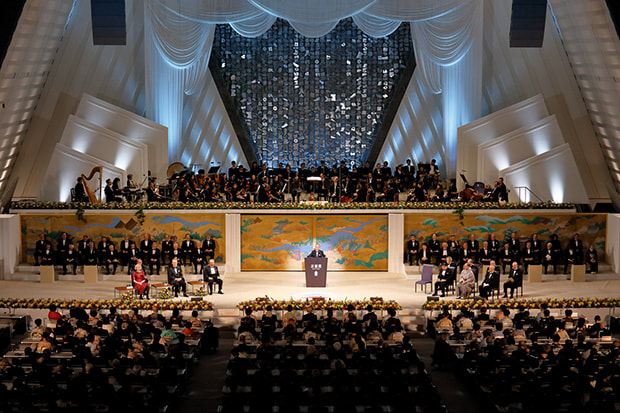
The Kyoto Prize is an international award that celebrates individuals who have contributed significantly to the advancement of society and humankind.
Using his own funds, Inamori established the non-profit Inamori Foundation in 1984, based on his lifelong belief that "people have no higher calling than to strive for the greater good of humankind and society." In keeping with this conviction, the foundation recognizes persons who have made outstanding contributions to the progress of science, the advancement of civilization, and the enrichment of the human spirit. It also supports excellent research through such programs as the Inamori Research Institute for Science (InaRIS) fellowships.
The following year, in 1985, the Inamori Foundation inaugurated its flagship initiative: an international awards program called the "Kyoto Prize."
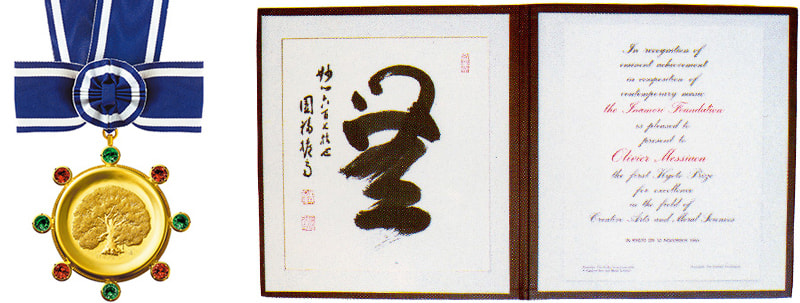
Kyoto Prizes are presented each year in the three categories of Advanced Technology, Basic Sciences, and Arts and Philosophy. Each laureate is presented with a diploma, a Kyoto Prize Medal, and a cash endowment.
Establishment of the Inamori Foundation
Applying himself earnestly in his work as an engineer and business manager from a young age, Inamori accumulated considerable personal assets as Kyocera grew and developed. However, he believed that "personal assets are held in temporary safekeeping for society, and should at some stage be returned to society." After receiving various awards for fine ceramics research and development, Inamori, prospering as a major shareholder in Kyocera, began to feel a bit embarrassed by the acclaim. He felt strongly that he should be the one giving awards to others who were dedicating their lives to making advancements in their fields.
As his conviction about this deepened, Inamori took action to put his philosophy into practice and give back to the society which had contributed to his company's success. Therefore, in April of 1984, at the age of 52, he established the Inamori Foundation with about 20 billion yen of his personal assets.
The Inamori Foundation endeavors to advance mutual international understanding and seeks to contribute to peace and prosperity among all people. Specifically, the Foundation operates through the following three activities: 1. The Kyoto Prize; 2. Research grants; and 3. Social contributions.
The Kyoto Prize Philosophy
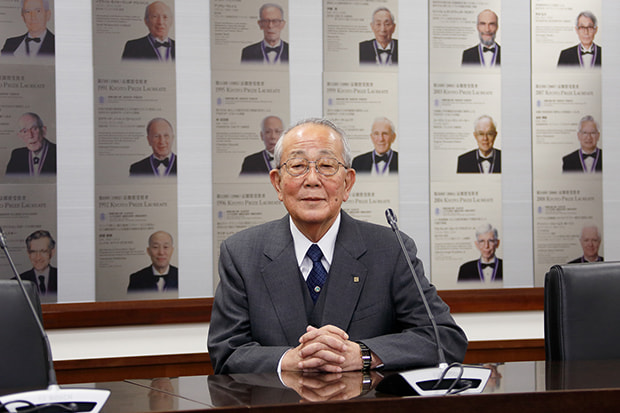
Since I founded Kyocera Corporation in 1959, I have devoted my life as a ceramic engineer to the development of a variety of ceramic materials, such as electronic ceramics, engineering ceramics, and structural ceramics. I believe that this work has contributed significantly to the establishment of our present-day era of fine ceramics.
This year, 1984, marks the twenty-fifth anniversary of Kyocera's founding. After a quarter of a century of relentless and painstaking effort, Kyocera's annual sales have, by the grace of God, grown to 230 billion yen, with pre-tax profits of 53 billion yen(*1). It has been my lifelong belief that a human being has no higher calling than to strive for the greater good of humanity and the world. In keeping with this conviction, I have decided on this occasion to create the Kyoto Prize as a means of recognizing persons who have made outstanding contributions to the progress of science, the advancement of civilization, and the enrichment and elevation of the human spirit. This award will be granted by the Inamori Foundation, which I have endowed with 20 billion yen(*2) in cash and Kyocera stock.
Those worthy of the Kyoto Prize will be people who have, as have we at Kyocera, worked humbly and devotedly, sparing no effort to seek perfection in their chosen professions. They will be individuals who are sensitive to their own human fallibility and who thereby hold a deeply rooted reverence for excellence. Their achievements will have contributed substantially to the cultural, scientific, and spiritual betterment of mankind. Perhaps most importantly, they will be people who have sincerely aspired through the fruits of their labors to bring true happiness to humanity.
I have two major reasons for establishing the Kyoto Prize. First, in keeping with my aforementioned belief that we on Earth have no higher calling than to serve the greater good of humankind and society, I wish in some way to repay the global community that has sustained and nurtured me all these years. Second, I would like to redress the relative lack of formal recognition for highly dedicated but unsung researchers. At the very least, I hope to honor people who have made extraordinary contributions to science, civilization, and spirituality and thereby to motivate them and others like them to reach still greater heights.
I am convinced that the future of humanity can be assured only through a balance of scientific progress and spiritual depth. Though today's technology-based civilization is advancing rapidly, there is a deplorable lag in inquiry into our spiritual nature. I believe that the world is composed of mutual dichotomies--pluses and minuses, such as the yin and the yang or darkness and light. Only through the awareness and nourishment of both sides of these dualisms can we achieve a complete and stable equilibrium. The progression or expansion of any one aspect alone without the other will inevitably upset the natural balance of the universe and contribute to human suffering. It is my sincere hope that the Kyoto Prize may serve to encourage the cultivation of both our scientific and spiritual sides. At the same time, nothing would be more gratifying than if it provided some small impetus for the construction of a new philosophical paradigm.
1984/4/12
Kazuo Inamori
*1 As per Kyocera's financial results for the fiscal year ended March 31, 1984
*2 As of 1984, when the Inamori Foundation was founded.
For more details on the Kyoto Prize, please visit the Kyoto Prize website.